Monday, July 18, 2011

How We Are Hungry


Read from Wednesday, July 6th to Thursday, July 7th.

How We Are Hungry, by Dave Eggers.  This is a collection of short stories by one of my favorite authors, Dave Eggers.  It is a small collection, and I read it very quickly one morning on a bus ride up to New York City.  Some stories are just a page long and involve an intimate moment in a character's life, while other stories are more in-depth and span a longer period of time.  I love Eggers' style of writing, and there are many animalistic elements to these stories.

One of the more memorable stories is 'The Only Meaning of Oil-Wet Water,' in which a young woman travels to Costa Rica to visit her friend Hand, a character from You Shall Know Our Velocity, and they spend the week surfing and hooking up.  It is about the spiritual zen of surfing, and about escaping from the ordinary routine of life and taking an adventure in an unknown land.  There are wild horses that watch the couple throughout their stay.  Another story is about a man who visits his cousin in the hospital after he tried to commit suicide for the umpteenth time.  One of the longer stories is about a woman who tries to climb Mt. Kilimanjaro. She is traveling alone, but with a tour group. Some of the tour group get sick and can't make it to the top, and then some of the porters, the black employees hired to climb and carry equipment, die in their sleep one night.  She eventually makes it to the top, mostly as a personal accomplishment.

There are other quirky stories that I enjoyed a lot as well.  One story is about a super-couple talking to their child, 'Your Mother and I.'  This story recounts how somehow they were able to bring about world-peace, solve all of humanity's problems, and even some minor problems as well.  It was so easy, they said, once everyone worked together and stopped dividing upon ideological extremes.  Another was just notes about a potential story Eggers would write in the future.  It is about an old man who wants to make his death a large, public event in a stadium.  He reconnects with his kids and an old flame to plan the thing, and it is the only way he would be happy dying.  Finally, the most interesting story, and the one that will stick with me, is the story 'After I was Thrown in the River and Before I Drowned.'  It is told from the perspective of a dog.  As a puppy, he was thrown in a river, but he was rescued and went to live with a family.  However, all the dog wanted to do was run in the woods at night with other dogs, that he could communicate with.  They had races for fun along a course that ended with a jump over a river.  One night, a dog jumped and broke her leg.  It is a bad omen, but the main dog wanted to race again.  He jumped, but the river was swollen from rain, and he drowned.  The story continues with life after death, including what it was like on the river bed, and then what dog heaven looked like; a giant field with nothing to do but roam around.  The story, and book, ended with this quote about his realization in heaven:

"The one big surprise is that as it turns out, God is the sun.  It makes sense, if you think about it.  Why we didn't see it sooner I cannot say.  Every day the sun was right there burning, our and other planets hovering around it, always apologizing, and we didn't think it was God.  Why would there be a God and also a sun? Of course God is the sun.  Everyone in the life before was cranky, I think, because they just wanted to know."

I liked these stories a lot, and I look forward to more by Dave Eggers.  Four out of five stars.

The Dharma Bums


Read from Tuesday, July 5th to Wednesday, July 6th.

The Dharma Bums, by Jack Kerouac.  It's been years since I last read On the Road, one of my favorites, and I have owned Dharma Bums for a long time now, and finally have got around to reading it.  It is a simple book consisting mostly of experiences living as one of these Dharma Bums in the early 1950's, mostly out west.  The characters are based on real people Kerouac knew, and the story takes place in the years before On the Road.

Ray Smith is the narrator, and he is a bum, but one of the old time romantic bums.  He is young, he catches trains, and he sleeps out under the stars.  He crashes at friend's houses, writes poetry, and also practices buddhism.  The story begins when Ray meets Japhy Ryder, another bum similar to Ray.  Japhy teaches Ray about the wonders of the outdoors, and the spiritual Zen of mountain climbing.  Together, along with one other friend, they climb the Matterhorn peak in California, spending nights sleeping outside, and days running and having fun along the trail, and meditating.  Dharma Bums is the name of the group that forms around these hikes and practices.  They also experience 'yab-yum,' a kind of Buddhist free love orgy. 

Ray hitchhikes home to North Carolina for the winter where he can sleep on his family's enclosed porch.  He still spends days meditating under a tree in the woods, surrounded by local dogs.  The family doesn't approve completely, and thinks he is a strange, black sheep, but they love him anyways.  In the spring, Ray hitchhikes back west to meet up with Japhy, and they spend the spring living together in a shack, throwing mad parties with lots of wine and poetry and jazz.  Finally, Japhy has to leave for a long trip to Japan to learn more about Buddhism, and they throw a three day massive party in his honor.  Towards the end of the party, Japhy and Ray grow tired of it all, and go for a long hike in the woods.  Once Japhy left, Ray hitchhiked up north to Washington State, where he had a job lined up to be a fire-watcher in a lonely, desolate cabin up on top of a mountain.  He spent the rest of the summer meditating by himself, finally at peace.

It is an interesting story, mainly because there is no conflict, just experiences pieced together.  Ray Smith is Jack Kerouac, and Japhy another of his poet friends.  Beautifully written, it is similar to OTR, but there is a definite contrast in the city life and the car, versus the nature and trail of Dharma Bums.  However, the spirituality of the road and trail and the vast, awesomeness of America is the same.  Of course, it makes me want to travel and hike and explore.  Three and a half out of five stars.

Sunday, July 10, 2011

Going After Cacciato


Read from Friday, July 1st to Tuesday, July 5th.

Going After Cacciato, by Tim O'Brien.  I started this book on July 1st, and I have made it my goal to read ten books in the month of July.  I will only read small and medium length books, of course, and so far I am on pace.  Need to read a book every three days, so even though this one took a bit longer (birthday weekend!), the next two were a lot shorter.  Anyway, Going after Cacciato was amazing.  It was talked about at length in How to Read Literature like a Professor, and that is how I found out about it.  It is a war novel, but also a psychological, experimental, and fantasy novel. 

Paul Berlin is the narrator, and he tells the disjointed story of Cacciato, another member in his unit, that one day decided to walk away from the Vietnam war, all the way to Paris.  Berlin relates the news about Cacciato going AWOL to their Lieutenant Corson, and he orders that the entire squad goes after him.  Berlin, Lieutenant, and a few others (Eddie, Stink, Oscar, and Doc) follow Cacciato through the mountains for a day or two, until they have him cornered on a hilltop.  At this point the story begins to get hazy, as Cacciato apparently escapes from that ambush, and continues onto Paris.  The group, including Berlin, continue their chase.

The whole story is not presented in chronological order.  In some chapters, Berlin is on a lookout post on a beach, keeping watch for an entire night, and he relates his thoughts on previous war experiences.  He had been with the squad a few months prior to Cacciato's disappearance.  They had a different lieutenant at that time, Sidney Martin, who made the soldiers check the tunnels prior to bombing them.  This led to two comrades being killed in the tunnels, but still Sidney Martin was stubborn, and insisted upon checking them, and so members of the squad contemplated killing him.  It is not revealed what ultimately happened to him.  Berlin also remembers other members of the squad that were killed, including one that had his face blown off, and another that had a heart attack after stepping on a mine, and literally died of fright.  These stories of the day to day life of Berlin and the other soldiers help to establish the fear and inner turmoil they felt, that ultimately led up to the chase. 

Back on the trail, after Cacciato escapes, they meet a young woman, Sarkin Aung Wan, on the trail traveling with her two aunts and two oxen, one of which is shot to pieces by trigger-happy Stink.  Sarkin is a refugee from the war, and she travels with them, becoming Paul Berlin's lover.  The squad falls into a hole at one point, all the way into an elaborate network of the Vietcong.  They are told they are held hostage, and cannot escape, but Sarkin shows them the way out.  It is simple, you just have to fall up.  This action establishes the story as fictional and not based in reality, and it works very well. 

After the tunnels, they leave the jungle and take a train across India to Delhi, where they stay as tourists for awhile.  The lieutenant falls in love with a woman there, and they have to kidnap him to get him to leave finally.  At this point the hunt for Cacciato is just a formality.  They are a squad of armed, uniformed soldiers venturing across the continent, supposedly still on their mission.  But Paul yearns for Paris himself, and a permanent escape from the horrors of the war.  After India, they spend some time in Tehran, Iran, where they are arrested for not having passports and for espionage, and they are sentenced to be executed.  But at the last moment, Cacciato arrives, gives them a gun, blows up the jail so they can escape, and provides a getaway sports car, and they escape the Middle East.  Cacciato disappears again after the escape, so they are still looking for him, all the way through Athens, Italy, and finally into Paris.

In Paris, the group becomes lackadaisical.  They spend days exploring the city, even though they claim to be looking for Cacciato.  Sarkin and Paul agree to find an apartment and permanently stay in the city.  Paul is conflicted.  He wants to be free and happy, but he also needs to finish his mission, and in the larger picture, the entire war, because the obligation is very strong.  Finally, he does find Cacciato one day, and the group surrounds him in the hotel he is staying at.  In a scene strongly reminiscent of the ambush on the hill, Berlin is terrified, pees his pants, and Cacciato escapes.  The scene is twisted, and it is revealed they are back on the hilltop in Vietnam, and Cacciato's story will never be revealed.  The next day, the squad returns to the war, and they are stationed at a look-out on the beach, where Berlin relates the workings of his imagination. 

This was an amazing, inventive story of what might happen if a soldier just decided to pick up one day and walk to Paris.  There is the external conflict, but also the inner turmoil of freedom and happiness versus obligations to your friends and country.  Much more than a war story, this is in a genre all on its own.  A full five out of five stars.

Thursday, June 30, 2011

A Confederacy of Dunces


Read from Tuesday, June 28th to Thursday, June 30th.

A Confederacy of Dunces, by John Kennedy Toole.  This book, both hilarious and tragic was excellent, and I could not put it down in the past two days.  Hands down, probably the funniest book I have ever read, and I literally laughed out loud for much of the time.  It is tragic solely because of the fact that it was published posthumously by Toole's mother, after the promising author had committed suicide when he was 32. 

This is a story of wild, crazy, fascinating characters, and diverse, but convergent storylines.  Ignatius J. Reilly is the unforgettable protagonist, a gigantic, 30 year old who lives at home with his mother in New Orleans.  He has a masters in medieval history, but no job or friends.  His mother, Irene, a widow, dotes on her son.  The story is set in motion one day at a department store, when Ignatius is accosted by a police officer for looking suspicious.  Ignatius, in his booming defense, uses his large vocabulary, his mother, and an old man complaining about 'communiss' to get away.  They go to a bar to hide out in the French Quarter, the Night of Joy, where Irene gets drunk and Ignatius tells the story of the one time he left New Orleans, on a Greyhound Sceniccruiser that made him sick and his 'valve' close up.  They meet Darlene, a waitress who wants to be a dancer, and Jones, an underpaid black porter. They are thrown out by the owner, Lana Lee, and Irene drives drunk into a building, and she is ordered to pay $1000 in damages.

Irene forces Ignatius to get a job to help pay the debt, and he finds one at Levy Pants, working on filing.  In the office, Miss Trixie is a senile old woman who only wants to retire, and Gonzalez is the loyal but incompetent office manager.  Ignatius tries to overhaul the office and spends his time redecorating and throwing the files in the trash.  At one point he impersonates the owner, Gus Levy, in a letter, responding with insults to a client.  Ignatius keeps in touch with a former girlfriend, Myrna from Brooklyn, who brags about doing something for social change.  She is an advocate of more sex in society, and Ignatius is very against that.  He wants to return to Medieval culture, with a strong king and clergy.  Anyways, in order to get back at Myrna, Ignatius tries to get the black factory workers to stage a revolt against the office.  It fails, and Ignatius is fired.  He then finds work as a hot dog vendor.

Meanwhile, Irene makes friends with the cop, and she also begins dating the old man complaining of communiss.  They complain about Ignatius, and the hold he has over Irene, and all agree that something must be done.  Also, at the Night of Joy, Lee is a strict boss, and also runs a strange business giving packages to George, a local teenager.  Jones is suspicious, but all Darlene wants is to dance.  She sets up a dance with her cockatoo, that pulls rings and tears off her clothes.  Gus Levy and his wife argue over the fate of the company in their posh mansion.  Gus wants to sell, but his wife said it would disrespect his late father. 

As a hot dog vendor, Ignatius struggles because he eats most of them himself.  He agrees to hold the packages for George in his hot dog cart, but opens one up and discovers naked pictures of Lana Lee.  Ignatius also meets an effeminate homosexual, Dorian Greene, and believes he has figured out how to bring about world peace; have the gays infiltrate all the military, and there will be no fighting.  This idea fails also when he is thrown out of their opening rally, and they go back to dancing.  Finally, Ignatius returns to the Night of Joy in order to see the naked woman in person, but he is attacked by Darlene's bird during her show.  He runs out of the bar and nearly is hit by a car before he faints.  The cop, Mancuso, shows up, and finally makes his big arrest of Lana, when Jones helps him find the packages of porno pictures.

Ignatius, and more importantly, Irene are embarrassed by the incident in the paper, and Gus Levy is finally able to track him down.  He accuses Ignatius of writing the letter, but Ignatius successfully pins it on Miss Trixie, who admits because she is senile and sees her opportunity at retiring.  Levy is able to avoid a lawsuit from this, and also creates a foundation to honor his father, and gives the first award to Jones.  Meanwhile however, Irene is finally convinced to send her son to a mental institution.  Ignatius gets worried about this one night, and he plans to escape.  Miraculously, Myrna shows up at that exact moment, and he uses her as an escape vehicle.  It does have a happy ending, as we are left with a grateful Ignatius on the open road with the one woman who is able to tolerate and understand him.

Extremely funny, I only wish there were more Ignatius Reilly.  I really wish for a film adaptation (possibly with Will Ferrell as Ignatius!).  It was full of very witty dialogue, and each character is both likable and idiotic.  The plot storylines twist and turn and finally intersect in the brilliant climax.  Wonderful book.  Four and a half out of five stars.

Tuesday, June 28, 2011

Great Expectations


Read from Sunday, June 19th to Tuesday, June 28th.

Great Expectations, the Dickens classic masterpiece.  This novel, published serially in a magazine in 1860, is one of the most famous by Dickens, and it tells the story from child to maturity of Pip, a poor country boy who rose unexpectedly to wealth.  It is a very rich story, with many symbols, themes and motifs, as well as an intricate plot with many interesting characters.  I will do my best to give a brief overview.

Pip, an orphan living in the country, near marshes and the ocean, one night is visiting his parents graves.  He discovers an escaped convict on the marshes, who orders him to go home, and bring back food and a file to escape from his chains.  Pip, being only seven, is terrified.  He goes home, to his sister and her husband, Joe.  His sister whips him for being out late, and she often goes on rampages.  Joe is calm, and simple, and good-natured.  The next morning, Pip sneaks out early and brings a pie and a file to the grateful convict.  He also comes across another man on the marshes.  Pip returns home, and is very guilty.  Later, the police come by, and Pip and Joe accompany them as they hunt the convicts.  Pip's convict is found beating up the other man, and both are returned to prison. 

Later in life, Pip is requested by a rich old lady, Miss Havisham, to play.  In her dilapidated Satis House, Pip walks her around, and plays cards.  She is eccentric, and has never seen the light of day, ever since she was jilted on her wedding day decades ago.  Pip also meets Estella, Miss Havisham's niece, who is Pip's age but treats him as inferior.  Pip falls helplessly in love with her, although she is cold, and confesses to be heartless.  She has been brought up by Miss Havisham to never fall in love, but instead to hurt men just like how she was hurt herself.  Pip returns again and again to the house, and he begins to resent his poor, uneducated upbringing.  He longs to be a gentleman and impress Estella.  Pip hopes that Miss Havisham will end up giving him money, and he is disappointed when she instead helps him to become Joe's apprentice as a blacksmith. 

Pip is not happy, and longs for more.  However, one day Joe's journeyman, Orlick, got in an argument with Pip's sister, and later that night she was attacked and is eventually killed.  Pip suspects Orlick, but nothing can be proved.  Pip's classmate Biddy moves into the house in order to take care of Mrs. Joe.  She is the perfect opposite to Estella, but Pip cannot realize that, and he wants out.  Finally, one day, he and Joe are surprised by a lawyer from London, who came on behalf of a secret benefactor to tell Pip he is to be a gentleman with great expectations.  Pip is very happy, but condescending to the rest of his family and town.  Of course he suspects Miss Havisham, and hopes that Estella is to be his wife.

He moves to London, but is not allowed to know the identity of the benefactor.  The lawyer, Mr. Jaggers, and his clerk Wemmick, are his guardians, but Pip lives with a young man, Herbert, and is tutored by a cousin of Miss Havisham, Matthew Pocket.  Pip must deal with the consequences of being rich.  He is embarrassed by Joe, but still regrets how he treated him.  He loves Estella, but she is very distant.  Wemmick and Herbert are both good friends, and they show him the value of working for money, and also being happy with what you have.  Finally, one stormy night, after Pip is much older (23) he is surprised by a stranger at his door.  It is the old convict, and he is actually Pip's mystery benefactor!  The convict, Abel Magwitch, had been exiled in Australia, but made his fortune as a farmer, and invested all his money in making Pip a gentleman, in order to repay him for the generosity years before.

Pip is horrified by Magwitch, and the actual source of his great expectations, and the fact that Estella was never meant for him.  Nevertheless, Magwitch must be hidden, since it is death for him if he is discovered by the police to be back in England.  Magwitch reveals his story, and how he always had to steal to survive.  He partnered with a gentleman criminal named Compeyson, and when discovered, Compeyson betrayed Magwitch to get a light sentence.  That was the other man on the marshes, and they were the two that fought.  Compeyson is out to get Magwitch, so he must be hidden.  Pip and Herbert and Wemmick work together to hide him until the time would be right to try and sail out of the country to safety. 

During this prolonged climax, many secrets are revealed.  Compeyson was actually the man who betrayed Miss Havisham by leaving her at the altar many years ago.  Magwitch is actually Estella's father, and Jagger's servant is her mother.  Pip goes back to Satis House to accuse Miss Havisham of leading him on, and to rebuke Estella for never loving him.  Estella is unmoved, but Miss Havisham is regretful of her actions, and begs Pip to forgive her.  She then is caught in a fire, and later dies.  Pip is then kidnapped by Orlick on the marshes and almost killed, but luckily Herbert followed and was able to rescue him. Orlick confessed to the attempted murder of his sister, and he was eventually arrested.  Orlick also confessed to spying on Pip and Magwitch in London on behalf of Compeyson.  The next day, Pip and Herbert take Magwitch downriver in an attempt to flee the country, but they are stopped by a police boat, with Compeyson on it as an informant.  Magwitch attacks Compeyson and drowns him, but he is arrested, although badly injured.

Magwitch is sentenced to death, but he dies naturally before hand, comforted by Pip's last words to him that his daughter is alive and that Pip loves her.  Pip becomes very ill after that, and is nursed back to health by Joe.  His money is gone, seized by the crown, and Pip resolves to make it up to the only family he really had, but had betrayed.  He goes home, thinking he will marry Biddy, but when he arrives, he discovers that Joe had already married her.  Pip, although disappointed, is immensely happy for the two of them, and decides to move to Egypt to work with Herbert at a shipping firm.  Many years later, he returns to find Joe and Biddy have a child named Pip, in honor of him.  Pip then walks by Satis House to find it nearly destroyed, but Estella standing in the ruins.  She owned the land after Miss Havisham died, and she and Pip walk off arm in arm, never to be separated again. 

The ending is controversial because it was not Dicken's original.  First, he had Pip and Estella meet, and he felt pity for her inability to love.  This revision is a happier ending, of course, although the first one probably goes along with the story better.  All in all, it is an epic tale of the dangers of wanting to become rich, the terrors of love, the abandonment of family, class differences, redemption, revenge, crime and punishment, and double personas.  It is full of symbols, such as Satis House, the marshes and the fog, the chains, Wemmick's castle, rivers, boats, fires, wedding dresses, and many others.  Pip is a likable narrator, who changes with age.  Though he is detestable at times, he redeems himself in the end by his acceptance of Magwitch for the inner nobility that he possesses.  Characters do change, and with the exception of Compeyson, all the bad ones are redeemed in the end.  Very good book, and not too difficult either, even though it was written in Victorian English.  Also there were many beautiful lines I was able to highlight.  Looking forward to watching a film adaptation.  Four and a half out of five stars.

Fluke


Read from Tuesday, June 14th to Friday, June 17th.

Fluke, by Christopher Moore.  I have read a bunch of books by Moore, and I always pleasantly enjoy his crazy, wacky humor.  My dad recommended this book a few years ago, and I finally got around to reading it.  Fluke is over the top, but funny.

Fluke is the story of a team of whale researchers in Hawaii.  Nate is a somewhat famous expert on the humpback whale song, but he is still frustrated by his inability to decipher the true reason for the song.  He is also frustrated by a few failed marriages and his new crush on Amy, the sexy research assistant who is much younger.  Clay, Nate's partner, is a whale photographer that is quite good-natured and optimistic.  There is also Kona, a rastafarian white guy from New Jersey.  He is a pothead, and dense, but ultimately is very loyal and unknowingly perceptive.

Things start getting weird when Nate sees a whale tail that says 'bite me.'  He thinks he is going crazy, and the photo he took disappears.  Then, their research lab is broken into and destroyed, and one of their boats sunk.  The team suspects other characters on the island, like a Navy captain looking for a place to test missiles underwater, and a government stool working to get whaling made legal again.  In the water, Clay gets close enough to take a picture of that strange whale, and then he hears people talking, and then he is knocked unconscious.  Amy dives down very, very deep, holding her breath for a long time, and rescues Clay.

Shortly after, Nate follows this whale, trying to get a good picture.  He goes into the water in order to get the ID, but he is swallowed by the whale!  Here is where you have to suspend reality.  Amy disappears soon thereafter, and Clay finds out she rowed away in the night.  Of course, Clay and Kona are very upset on land, but they soon learn after the funeral, that there is a way to decipher the whale song in a binary code, corresponding to the peaks and troughs of the wavelengths.  They find messages encoded, one mentioning that Nate and Amy are all right.  On land, they set up a rescue mission, buying a boat and crew and finding out more about the underwater signals. 

Nate awakes in the belly of the whale.  There are two other humans there, and though small and cramped, it is like a submarine.  It is piloted by two 'whaley-boys,' creatures that look half-human and half-whale, and tap into the central nervous system of the whale ship and control everything.  The humans, we learn, were both eaten by the whale many years ago, and they love being pilots in the ship.  Nate is transferred over to another whale, this one blue, and speaks with many other human captives.  They are all very grateful for being saved by the whale, and they take Nate to a gigantic subterranean city called 'Goo-ville.'  Everything is controlled by the Goo, which is a giant, living, prehistoric organism that surrounds the city, and is the city.  It adapts to whatever needs the inhabitants have.  Literally, the walls and furniture are alive.  Nate is surprised by Amy, (who has sex with him a lot), and finds out she is originally from the city, and sent above to spy on Nate so he doesn't find out too much about the whale song.  Amy is really the daughter of Amelia Earhart, and people hardly ever age due to the healing power of the Goo.  Nate also meets the Colonel, who is the human leader of the city.  The Colonel is actually an old biologist colleague of Nate who disappeared many years ago. 

The Colonel wanted Nate brought in alive because he wanted help with his plan.  He wants to destroy the Goo completely, hopefully by blowing it up with nuclear bombs.  The Goo has been living underwater for millions of years, and it is highly adaptable through its genes.  It is only recently that it became aware of human activity on the surface because of whaling.  That is when it created the whale ships and the whaley-boys.  According to the Colonel, there is a war about to break out between humans and the Goo, and it is a war between genes and memes.  Humans have mastered the ability to replicate ideas among the population (memes), and the Goo wants to destroy that.  Nate refuses to help, and only wants to escape, but he becomes forcibly held by the city.  The Colonel is executed, and Nate is only spared through help from Amy.  Finally they are rescued by Clay, who arrives just in time.  However, Amy cannot leave the city, she cannot be away from the Goo for a long time.  She will now become leader of the city. Clay and Nate return to Hawaii, and Nate finally learned what the whale song did; it was a prayer for fish and food, and it had the ability to create krill out of regular sea water. 

Like all that Moore writes, this story is fun, interesting, with lots of crude humor.  One of the more memorable parts is when Nate's wife at the time, went on a whaling expedition, but got caught up in a mating, and the male whale though the ship was a female whale, and, well, you get the picture.  After her experience with those gigantic 'creatures,' she became a lesbian.  It is also a fascinating and creative story, and a light-hearted read.  I also recommend Lamb and Fool.  Three and a half out of five stars.

Tuesday, June 14, 2011

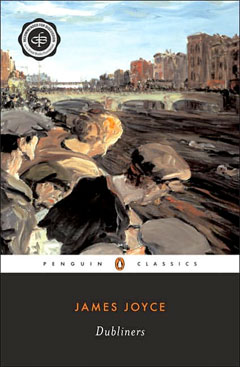
Dubliners


Read from Monday, June 13th to Tuesday, June 14th.

Dubliners, by James Joyce.  Dubliners is a collection of fifteen short stories, each centering on different characters in his Irish city around the turn of the century.  It encompasses many of the themes of Irish life at that time; the burgeoning issue of national identity, politics, Catholicism, alcoholism, as well as themes of life in general, such as poverty, love, upward aspirations, and mortality. 

The stories are arranged chronologically, in that the age of the main character progresses in each one.  A young boy mourns the death of his priest and mentor, while others treat it superficially.  Two boys play hooky from school down by the docks, where they meet a strange man.  Another boy develops a crush on his friend's sister, and he travels to the Arab bazaar in town to buy her a present, but the bazaar is almost closed, and he is frightened.  A young girl plans to sail away with a man to Argentina, but she chickens out at the last minute.

In another story, a mother who manages a boardinghouse learns her daughter is having an affair with one of the boarders, so she tries successfully to get him to marry her, and ensures a prosperous life.  Another mother signs her daughter up to play a series of concerts, but when they are sparsely attended, she demands payment.  She does not get her daughter paid, and the mother makes the daughter storm off, and they are disgraced.  Another elderly woman visits the home of her foster son one Halloween. 

As for men, there is an alcoholic clerk Farrington, who is lazy and gets in an argument with his boss then goes out for a night of debauchery on the town, loses an arm-wrestling contest, and goes home to beat his son.  Another, Little Chandler, has dinner with an old friend who is successful in London as a reporter, and he reflects on his own success in family life.  There is a scene about Irish politicians and their staff as they try to campaign and talk about the politics of the day, in the wake of Parnell.  Another story focuses on a quiet, solitary man, who rebukes a married woman's affections, and years later finds out that her sadness led to an early death.  In another one, an old alcoholic man falls down the stairs and is injured.  His friends try to help him by tricking him to convert to Catholicism

Finally, there is the story "The Dead," which tells of Gabriel Conroy and his wife Gretta.  They go to a Christmas party at his spinster Aunt's house, and they dance, and feast.  When they return to their hotel, Gabriel wants his wife, but she is distracted.  A song she heard that night reminded her of an old boyfriend, who waited in the cold to see her and caught pneumonia and died.  Gabriel reflects upon life and death, and how everyone he knows will be dead sooner or later.

They are each powerful stories, some more so than others.  There are other stories I did not relate that weren't as moving.  Each story has a small epiphany for the main character, that makes them hopefully change their ways.  Many characters also reappear later in Ulysses, one of my favorites.  Enjoyable, easy read.  Three and a half out of five stars.