Tuesday, June 28, 2011

Fluke


Read from Tuesday, June 14th to Friday, June 17th.

Fluke, by Christopher Moore.  I have read a bunch of books by Moore, and I always pleasantly enjoy his crazy, wacky humor.  My dad recommended this book a few years ago, and I finally got around to reading it.  Fluke is over the top, but funny.

Fluke is the story of a team of whale researchers in Hawaii.  Nate is a somewhat famous expert on the humpback whale song, but he is still frustrated by his inability to decipher the true reason for the song.  He is also frustrated by a few failed marriages and his new crush on Amy, the sexy research assistant who is much younger.  Clay, Nate's partner, is a whale photographer that is quite good-natured and optimistic.  There is also Kona, a rastafarian white guy from New Jersey.  He is a pothead, and dense, but ultimately is very loyal and unknowingly perceptive.

Things start getting weird when Nate sees a whale tail that says 'bite me.'  He thinks he is going crazy, and the photo he took disappears.  Then, their research lab is broken into and destroyed, and one of their boats sunk.  The team suspects other characters on the island, like a Navy captain looking for a place to test missiles underwater, and a government stool working to get whaling made legal again.  In the water, Clay gets close enough to take a picture of that strange whale, and then he hears people talking, and then he is knocked unconscious.  Amy dives down very, very deep, holding her breath for a long time, and rescues Clay.

Shortly after, Nate follows this whale, trying to get a good picture.  He goes into the water in order to get the ID, but he is swallowed by the whale!  Here is where you have to suspend reality.  Amy disappears soon thereafter, and Clay finds out she rowed away in the night.  Of course, Clay and Kona are very upset on land, but they soon learn after the funeral, that there is a way to decipher the whale song in a binary code, corresponding to the peaks and troughs of the wavelengths.  They find messages encoded, one mentioning that Nate and Amy are all right.  On land, they set up a rescue mission, buying a boat and crew and finding out more about the underwater signals. 

Nate awakes in the belly of the whale.  There are two other humans there, and though small and cramped, it is like a submarine.  It is piloted by two 'whaley-boys,' creatures that look half-human and half-whale, and tap into the central nervous system of the whale ship and control everything.  The humans, we learn, were both eaten by the whale many years ago, and they love being pilots in the ship.  Nate is transferred over to another whale, this one blue, and speaks with many other human captives.  They are all very grateful for being saved by the whale, and they take Nate to a gigantic subterranean city called 'Goo-ville.'  Everything is controlled by the Goo, which is a giant, living, prehistoric organism that surrounds the city, and is the city.  It adapts to whatever needs the inhabitants have.  Literally, the walls and furniture are alive.  Nate is surprised by Amy, (who has sex with him a lot), and finds out she is originally from the city, and sent above to spy on Nate so he doesn't find out too much about the whale song.  Amy is really the daughter of Amelia Earhart, and people hardly ever age due to the healing power of the Goo.  Nate also meets the Colonel, who is the human leader of the city.  The Colonel is actually an old biologist colleague of Nate who disappeared many years ago. 

The Colonel wanted Nate brought in alive because he wanted help with his plan.  He wants to destroy the Goo completely, hopefully by blowing it up with nuclear bombs.  The Goo has been living underwater for millions of years, and it is highly adaptable through its genes.  It is only recently that it became aware of human activity on the surface because of whaling.  That is when it created the whale ships and the whaley-boys.  According to the Colonel, there is a war about to break out between humans and the Goo, and it is a war between genes and memes.  Humans have mastered the ability to replicate ideas among the population (memes), and the Goo wants to destroy that.  Nate refuses to help, and only wants to escape, but he becomes forcibly held by the city.  The Colonel is executed, and Nate is only spared through help from Amy.  Finally they are rescued by Clay, who arrives just in time.  However, Amy cannot leave the city, she cannot be away from the Goo for a long time.  She will now become leader of the city. Clay and Nate return to Hawaii, and Nate finally learned what the whale song did; it was a prayer for fish and food, and it had the ability to create krill out of regular sea water. 

Like all that Moore writes, this story is fun, interesting, with lots of crude humor.  One of the more memorable parts is when Nate's wife at the time, went on a whaling expedition, but got caught up in a mating, and the male whale though the ship was a female whale, and, well, you get the picture.  After her experience with those gigantic 'creatures,' she became a lesbian.  It is also a fascinating and creative story, and a light-hearted read.  I also recommend Lamb and Fool.  Three and a half out of five stars.

Tuesday, June 14, 2011

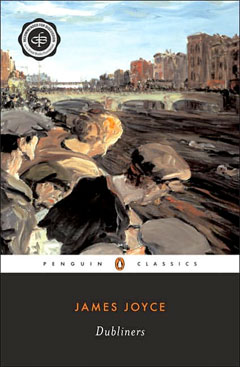
Dubliners


Read from Monday, June 13th to Tuesday, June 14th.

Dubliners, by James Joyce.  Dubliners is a collection of fifteen short stories, each centering on different characters in his Irish city around the turn of the century.  It encompasses many of the themes of Irish life at that time; the burgeoning issue of national identity, politics, Catholicism, alcoholism, as well as themes of life in general, such as poverty, love, upward aspirations, and mortality. 

The stories are arranged chronologically, in that the age of the main character progresses in each one.  A young boy mourns the death of his priest and mentor, while others treat it superficially.  Two boys play hooky from school down by the docks, where they meet a strange man.  Another boy develops a crush on his friend's sister, and he travels to the Arab bazaar in town to buy her a present, but the bazaar is almost closed, and he is frightened.  A young girl plans to sail away with a man to Argentina, but she chickens out at the last minute.

In another story, a mother who manages a boardinghouse learns her daughter is having an affair with one of the boarders, so she tries successfully to get him to marry her, and ensures a prosperous life.  Another mother signs her daughter up to play a series of concerts, but when they are sparsely attended, she demands payment.  She does not get her daughter paid, and the mother makes the daughter storm off, and they are disgraced.  Another elderly woman visits the home of her foster son one Halloween. 

As for men, there is an alcoholic clerk Farrington, who is lazy and gets in an argument with his boss then goes out for a night of debauchery on the town, loses an arm-wrestling contest, and goes home to beat his son.  Another, Little Chandler, has dinner with an old friend who is successful in London as a reporter, and he reflects on his own success in family life.  There is a scene about Irish politicians and their staff as they try to campaign and talk about the politics of the day, in the wake of Parnell.  Another story focuses on a quiet, solitary man, who rebukes a married woman's affections, and years later finds out that her sadness led to an early death.  In another one, an old alcoholic man falls down the stairs and is injured.  His friends try to help him by tricking him to convert to Catholicism

Finally, there is the story "The Dead," which tells of Gabriel Conroy and his wife Gretta.  They go to a Christmas party at his spinster Aunt's house, and they dance, and feast.  When they return to their hotel, Gabriel wants his wife, but she is distracted.  A song she heard that night reminded her of an old boyfriend, who waited in the cold to see her and caught pneumonia and died.  Gabriel reflects upon life and death, and how everyone he knows will be dead sooner or later.

They are each powerful stories, some more so than others.  There are other stories I did not relate that weren't as moving.  Each story has a small epiphany for the main character, that makes them hopefully change their ways.  Many characters also reappear later in Ulysses, one of my favorites.  Enjoyable, easy read.  Three and a half out of five stars.

A Visit from the Keith Squad


Read from Tuesday, June 7th to Saturday, June 11th.

A Visit from the Goon Squad, by Jennifer Egan.  I really enjoyed this new novel, and since it had been earning a lot of praise recently, I eagerly awaited its release in paperback.  Egan uses a really "novel" concept in her book: each chapter is from a different period of time, and focuses on a different character, often loosely related to other characters.  For the most part, it is the story of Bennie Salazar and his assistant, Sasha (at the present time).  However, different chapters explore their past, focusing on crucial moments as teenagers, young adults, in their marriages.  There are also chapters in the near future, with interesting views on technology.  

It is difficult to sum up the overall plot, but here it goes.  Bennie Salazar grew up in San Francisco as a punk rocker.  He started a band with his friend Scotty called the Flaming Dildos.  One of their close friends meets a sleazy record producer, Lou, at one of their shows and becomes his new girlfriend.  Lou has six children, and we meet some of them and one of his wives on a trip to Africa in one chapter.  The band breaks up and Bennie eventually hits the big time discovering a band called The Conduits, and he is a big-shot in the music industry.  His marries a woman named Stephanie, and they move to New York, but have trouble fitting into a country club with the other rich snobs.  (Here we go off on a tangent,) Stephanie has a brother Jules, who was an entertainment reporter, and he was arrested for attempted rape of a young starlet, Kitty Jackson.  Stephanie and Jules go into the city one morning and meet her client (Stephanie is in PR), Bosco, the former guitarist of the Conduits.  Bosco is old and fat and sick, and he proposes one final tour that will end up killing him, so he can go out with a bang.

Later we learn about Stephanie's boss, Dolly, who ends up being disgraced from her profession after an oil accident at a party she threw.  She is desperate for money so her daughter Lulu can attend a private school, and she ends up doing secretive PR work for a brutal dictator-general in a country unnamed.  She recruits Kitty Jackson to be his girlfriend, so he can have a more positive image in the press. 

Sasha is Bennie's assistant in the present-day.  He is attracted to her, especially since his wife Stephanie left him.  However, Sasha is a compulsive kleptomaniac, always stealing whatever she can.  We learn that as a teenager she ran away from home all over the world.  She ended up in Italy, where she pick-pocketed tourists and prostituted herself with a gangster.  Her uncle was sent over by her parents to find Sasha, and he ended up stumbling upon her.  She stole his wallet, and he almost gave up, but he persisted and managed to bring her home.  Sasha went to college and managed to turn it around.  Her close friend Rob fell in love with her, but she didn't feel the same way.  Sasha dated a promising man named Drew, and one night Rob and Drew took ecstasy and ended up swimming in the river, but Rob drowned. 

In a chapter consisting entirely of power-point slides, we learn in the near-future that Sasha reconnected with Drew years later after working for Bennie, and they married and had two children.  Her daughter made the slides, about her relationship with her parents, and her brother Linc's obsession with pauses in the middle of rock and roll songs.  Finally, in the future as well, Bennie is an aging and irrelevant executive, but he tries once again to promote his client, and old friend, Scotty, who is a reclusive artist.  Bennie and his protege Alex and new assistant Lulu, manage to influence the blogosphere to create buzz for Scotty's free concert.  Egan tells of a future where everyone is interconnected with technology, and you only had to point to get songs, and people mainly communicate via an abbreviated texting language.  Scotty's concert is a success, and the title of the book is explained at the end.  Time is the goon squad, always hunting you down, and always behind you.  Time cannot be overcome, and it will get you in the end. 

This is the overall theme of the book, as it examines the interconnected life stories of the very well-developed characters.  Music is ever-present as well.  I also really enjoyed Egan's propensity to experiment with different forms.  One chapter is a newspaper or magazine article (about Jules and Kitty), another is only power-point slides, and other experiment with the point of view, shifting from first to third and even second.  My plot summary does not do the story justice, and it is always interesting to see certain characters, even peripheral ones, resurface many years later.  Funny, moving, and poetic, this book is highly recommended.  Four and a half out of five stars.

Monday, June 13, 2011

The Bad Keith


Read from Wednesday, June 1st to Monday, June 6th.

The Bad Girl, by Mario Vargas Llosa.  I had been meaning to return to Vargas Llosa for awhile now, ever since I read The War of the End of the World.  This book, the Bad Girl, is much different, with a completely new and more light-hearted tone.  At its heart, this is a love story between Ricardo and 'the bad girl,' but it encompasses the entire history of the world in the second half of the 20th century. 

Each chapter in the book tells a story of Ricardo and the bad girl from a different time in their lives, chronologically, up til her death.  Each time, many of the themes are repeated and the story plays out in a similar way; Ricardo is madly in love with the bad girl, she lets him give her attention, then she leaves suddenly for a richer guy or otherwise betrays him.  Ricardo meets the bad girl when he was a teenager in Peru.  One summer, she appears as Lily, a new Chilean immigrant to the neighborhood.  He falls in love, but she will not agree to be his girlfriend, even though they hang out all the time.  Finally, it is revealed that she was just pretending to be Chilean to be popular, and she was Peruvian the whole time. 

They lose contact after that, and many years go by.  Ricardo moves to Paris, where he works as a translator.  This is in the 1960's, after the Cuban revolution, and Ricardo's friend runs a program where he gets young Peruvians to train in Cuba in order to bring a revolution to Peru.  One of these young revolutionaries is the bad girl.  They reconnect, and finally sleep together.  Ricardo once again professes his undying love, but she is indifferent.  Content to be treated like a princess, she teases Ricardo and his many 'sentimental' sayings.  She does not believe in love, but just wants to move up in the world.  She is not a revolutionary, but she just pretended to be in order to get out of Peru.  However, she is obliged to go to Cuba, and Ricardo cannot stop her. 

Years later, the bad girl turns up again in Paris, but this time as the wife of a bureaucrat she met in Cuba.  Ricardo is still obsessed, and they have an affair.  He is very happy for a time, even though she remains reserved.  Once again, she disappears suddenly.  Ricardo hears from her husband, and he says that she ran off with another man, and she stole all his savings.  Ricardo is very hurt again, and he resolves to stop becoming obsessed with this shape-shifting woman.  Years go by, and Ricardo becomes an expert translator.  He has a few minor girlfriends, but none that stick.  He reconnects with an old friend from Peru in London, one of the first hippies.  In London, he finds the bad girl again, this time as the wife of a rich international businessman that is obsessed with horse breeding.  Ricardo travels from Paris to London almost weekly and he meets the bad girl in a hotel to continue their affair.  But when the husband gets suspicious, the bad girl returns to him, leaving Ricardo alone.

They next reconnect in Tokyo years later.  The bad girl is one of the girlfriends of a Japanese gangster, and she goes on smuggling missions for him to Africa.  The bad girl is obsessed with this mafioso, and he has a powerful hold on her.  They all go out together, and the bad girl is affectionate with Ricardo, and she takes him home to sleep with him.  However, Ricardo sees that the gangster is masturbating in a corner.  The bad girl only did it to give him a sick voyeuristic pleasure.  Ricardo storms out and does not speak to her for many years, even though she tried getting in touch every few months.  Finally, with the help of his neighbor, a mute child, Ricardo agrees to meet the bad girl again.  She had left the gangster, but she was very mentally distraught and very sick.  Ricardo puts her in a clinic where she is able to get better.  She claimed she was gang-raped in Lagos, but really the therapist found out she was just very mentally abused.

Ricardo is the only person in her life that she could turn to.  He nurses her back to health, and she gradually returns to a normal life.  She agrees to marry him, mainly in order to get a legal status in Paris so she can work.  She appears to be a normal, loving wife, even though Ricardo is very nervous she will run off again. At one point, she almost leaves, and Ricardo almost commits suicide.  Of course, eventually she does leave him, although they talk about it first and have a normal break-up.  Ricardo moves to Madrid with a young playwright.  The bad girl finds him there many years later.  This time, she is very sick, and close to dying from cancer.  Together, they move in together and have a few months as a normal happy couple before she dies.  The bad girl leaves all her money and some land in the south of France to Ricardo.

It is an interesting life story of obsession with the one girl that could make him happy, even though she destroyed him many times.  It follows politics as well, mostly of his home country of Peru, but also of France, England and the rest of the world.  It is fitting that Ricardo works as a translator.  Even though he can speak many languages, he feels like he doesn't have a natural home.  The only time he is really happy is with the bad girl.  Even though it was a bit repetitive at times, each chapter and meeting between the two is a little different, and the characters grow more complex as the story develops.  The bad girl is given a history as a young girl in Peru that was very poor, with a father that designed breakwaters.  She yearned to be something more and different, even though she treated people poorly along the way, especially poor Ricardo.  Three out of five stars.

Wednesday, June 1, 2011

Factotum


Read from Friday, May 27th to Tuesday, May 31st.

Factotum, by Charles Bukowski.  The final Bukowski book that I own, although I will probably buy more.  I'm especially interested in checking out some of his poetry collections.  Once again, we follow the story of Henry Chinaski, around the end of WWII when he was still young and an unknown writer.  Chinaski drifts around the country from job to job, from woman to woman, from drink to drink.

There is not a traditional plot structure, and not much growth, and no real climax.  But these stories are centered around his many different jobs, and the things he does to get them, and his inane actions to lose them.  He works in factories, as a shipping clerk, as a receiving clerk, as a stockboy, as a janitor.  He tries to be a taxi driver, but has a drunk driving arrest.  He sends stories to different magazines, but mostly they are rejected.  He lives with a woman named Jan for awhile, and they have crazy sex, drink lots of wine, and she supports his job search.  Although when he starts winning money at the horse races, she loses interest, apparently only interested in Chinaski while he is a deadbeat.  Chinaski is also involved briefly with a woman named Laura, who, along with two other women, are essentially live in prostitutes for an old rich man.  Chinaski is hired by this man to write lyrics for his opera, although mostly he just drinks and has sex with the women on the yacht, until the old man has a heart attack and dies.

Chinaski is a pathetic man, but he offers very lucid statements on the hopelessness of the American workplace.  Workers are expected to get up very early in order to slave away, making money for a man, and they are expected to act grateful for the opportunity to be able to do this.  Chinaski always goes into a job expecting and waiting to be fired, so he slacks off and has an easy-going personality, that many mistake for confidence.  He goes to bars while working, slips off early to go to the racetrack, has sex with women in the office, sleeps in bathrooms while an overnight janitor, and other deplorable acts.  However, he has the reader's sympathy.  It ends pathetically, with him unable to get a job picking tomatoes on a farm with other bums, and instead going to watch a stripper, unable to even get it up.  Three and a half out of four stars.

Keith Unnamed


Read from Tuesday, May 24th to Friday, May 27th.

The Unnamed, by Joshua Ferris.  Found this book while browsing at a Barnes and Noble, and I was intrigued by the cover and the basic premise.  A man can't stop walking.  After a slow and rocky start, the novel really hit its stride (pun intended), and it became a deep, philosophical exploration of love, the relationship of mind and body, and the American desire and curse of constant movement.  

Tim Farnsworth is a partner in a successful NYC law firm.  He has a wife, Jane, and a daughter Becka, but also a terrible, unnamed disease that makes him walk.  Literally, he can be doing anything and he will get a sudden impulse and not be able to stop walking for hours at a time.  He can't control where he goes, and he only stops when he passes out into a deep sleep.  When he wakes up, he calls Jane, and she dutifully drives out to pick him out.  Tim had two previous periods of time when the disease had him in control, but both times it went into remission.  Tim was able to go back to work each time, and regain some hope that it wouldn't happen again.  Tim had been to every specialist under the sun, but none could agree on what was happening.  Some said it was psychological, and others said it was a brain malfunction.  Being unable to define the disease is the most frustrating thing to Tim, and he keeps it a secret from most of his friends and co-workers. 

The third time the disease appears is the present story.  Tim is working on a big murder defense case for the firm's most important client.  Suddenly, he starts walking again, and each morning he is picked up again by Jane.  It causes friction in the marriage, as Jane starts fantasizing about leaving Tim for a less stressful relationship, and Tim grows more depressed and contemplates suicide.  Tim ends up being kicked off the case and loses his partner position in the firm.  Finally Tim decides he cannot control it any longer and he lets his feet take him wherever they want.  Tim doesn't call home after each walk, and he walks further and further away, all the way to the south, where Jane tracks him down in a diner that the deranged Tim pretends is his lawyer office, and the waitress his secretary.  Jane tries to get him to come home with her, but Tim makes one of the hardest decisions of his life and stays on his journey.  He does it out of love, and the desire to protect Jane and let her move on and not worry about him.  

Tim takes psychotic medication, and that helps with his psychosis, because for awhile he was having conversations between his mind and body.  Yet he continues to wander, and he gets good at it, traveling with a tent and supplies and steering clear of the authorities.  Finally, he hears from his daughter Becka that Jane is sick with cancer, so he makes up his mind to walk back to New York.  Even though his feet take him in any direction while he is possessed, when Tim regains control he walks East.  It takes a long time, but he makes it to the hospital, and Jane magically recovers.  But still Tim cannot stay.  He resumes his walking, and months later he finds out that Jane died.  Tim eventually succumbs to the elements and passes away, finally able to rest. 

One thing about this novel I particularly enjoyed was the bizarre background scenery.  It is set in a world with extreme weather, which I took as a parallel to the craziness of Tim and the modern world.  Everyone is going berserk.  There are constant forest fires, days upon days of snow, floods, tornadoes, hurricanes.  But Tim walks through it all.  A criticism of the novel is that it is too disjointed.  There is a murder case, but Tim never finds the mysterious man he met on a bridge that showed him the murder weapon.  That whole plot-line is dropped completely.  The medical mystery is also unclear, even though it is Tim's obsession.  Finally, the first part of the story is a traditional plot line, but then it is just inter-spliced episodes that go back and forth in time.  Overall, I enjoyed the novel, even though it ended bleakly without much hope.  Three and a half out of five stars.

Keith Crossing


Read from Tuesday, May 17th to Monday, May 23rd.

The Crossing, by Cormac McCarthy.  This is the second book in his magnificent Border Trilogy, All the Pretty Horses being the first.  Although second in the trilogy, this is a wholly new story, new cast, although in similar locations surrounding the U.S.-Mexico border.  I really enjoyed this novel, although it was darker and more complex than ATPH.  There is not a traditional plot, and the mix of languages could be tricky at times.  If you are not competent in Spanish, then don't bother reading this book. I took Spanish classes for many years in school, and I was able to follow conversations pretty well, but lots of dialogue happens in Spanish without much contextual help for its meaning.  As I said, this book is darker, more deaths, and there is not a satisfactory ending.  Of course, it reveals deep truths about life, but the American in me wanted revenge, and lots of it. 

Billy Parnham, the protagonist, is a 16 year old living on a New Mexican ranch in the late 1930's.  His younger brother is Boyd, and he has got a father and mother.  In the very beginning, Billy and Boyd run into an Indian on their ranch, and the Indian demands they give him food.  They give him some, but when he wants more, they run away and leave the Indian out there.  Later, Billy works with his father to catch a wolf that has been plaguing their lands and eating cattle.  They track the wolf, set up traps, but she always evades them.  Finally, Billy, while acting on his own, sets a trap in an old fire pit and catches the wolf.  However, instead of shooting her, he makes a muzzle and a leash and leads the wolf back across the border into Mexico, where she came from.  The wolf is injured, but he bandages her leg, and they eventually bond somewhat.  But, while crossing a river, he is arrested by the police and the wolf is confiscated and given to a carnival.  Billy tracks the wolf, trying to rescue her, but she ends up being given to a local crime boss.  The gangster sets up a dog-fighting ring on his ranch, and dog after dog is sent into the ring to fight the wolf.  She fights them off as best she can, but they keep throwing new, fresh dogs at her.  Billy cannot do anything but watch in horror, and when he goes into the ring to stop it, he is threatened to be shot, so he is forced to walk away.  Finally, he cannot take it anymore and walks back in with a shotgun and puts the wolf out of her misery.  He buys the carcass off the gangsters and leaves for the mountains, where he buries the wolf.  Billy then rides around for a few months, living like a hermit in the mountains, finally meeting a preacher in an abandoned town hit by an earthquake. 

Billy crosses the border back to the U.S., but something is wrong when he gets to his ranch.  His parents have been brutally murdered, most likely by the Indian.  All their horses have been stolen as well.  Boyd is living with a local family, and they reunite and travel to Mexico together, hoping to catch the killers and find their horses.  They find one horse in a village, and they steal it back, and they briefly try to track the paper trail of the horse across Mexico to a horse dealer, but they run into a dead end.  They still wander, searching for something, when they run into a young girl about to be raped by two riders.  They rescue her, and Boyd and the girl fall in love on the road.  Eventually, they find a ranch where a bunch of their horses are held, and they persuade one guy to give them back, but another boss sets out after Billy and Boyd to get them back.  There is a gunfight, and Boyd is shot in the chest.  Billy manages to get him to safety, and Boyd recovers after many weeks.  But one morning, Billy wakes up to find that both Boyd and the girl have run away.

Billy searches all throughout Mexico for them, and he hears songs being sung about their exploits.  However, he cannot find them, and he crosses back into the U.S.  WWII has started, and Billy tries to enlist, but he is medically rejected for an irregular heartbeat.  He drifts from job to job for years around the Southwest, but finally decides to go back to Mexico one more time.  He travels around, looking for Boyd, who by now has become a mythical figure of a revolution in many villages.  He hears stories that Boyd was killed in a gunfight, and finally it is confirmed and Billy finds the grave.  He resolves to bring the body back to the U.S. for a proper burial, so he exhumes the grave and carries the bones back with him.  At one point he meets a band of robbers that end up stabbing his horse, and he has to stop for awhile and nurse the horse back to riding condition.  Back in the U.S., he is able to bury Boyd on their old ranch.  In the final scene, Billy finds an abandoned building that he takes shelter in from a storm.  An old, mangy dog tries to stay there with him, but Billy kicks the dog out into the storm.  Shortly thereafter he has a change of heart and tries to call the dog back, but he is nowhere to be found, and Billy breaks down sobbing on the road.

It is a story of three border crossings, but also about the crossing between life and death, youth and maturity.  After reading the previous book, How to Read Literature like a Professor, I can recognize many symbolic pieces of the story.  Mexico represents a sort of Underworld Hades that the hero must journey through.  Crossing a river is important, and Billy also suffers a heart ailment.  At one point, Billy pays a border guard to get into Mexico, which is like paying the ferryman to cross the River Styx.  It is a novel about loneliness and injustice, while trying to do the right thing.  Billy never gets revenge for the murder of the wolf, his family and his brother, which unfortunately is similar to real life.  It is depressing, especially the final, symbolic scene, but it makes you see the realistic harshness of the world.  As always, McCarthy's prose is beautifully haunting, and the imagery is fantastic.  The horse-riding jargon and Spanish language can be tricky, but it was a wonderful read.  Four out of five stars.